
How Tanaya Amar Is Connecting Data Analytics, Technology and Better Business Decisions- PARAHUSHAR NEWS
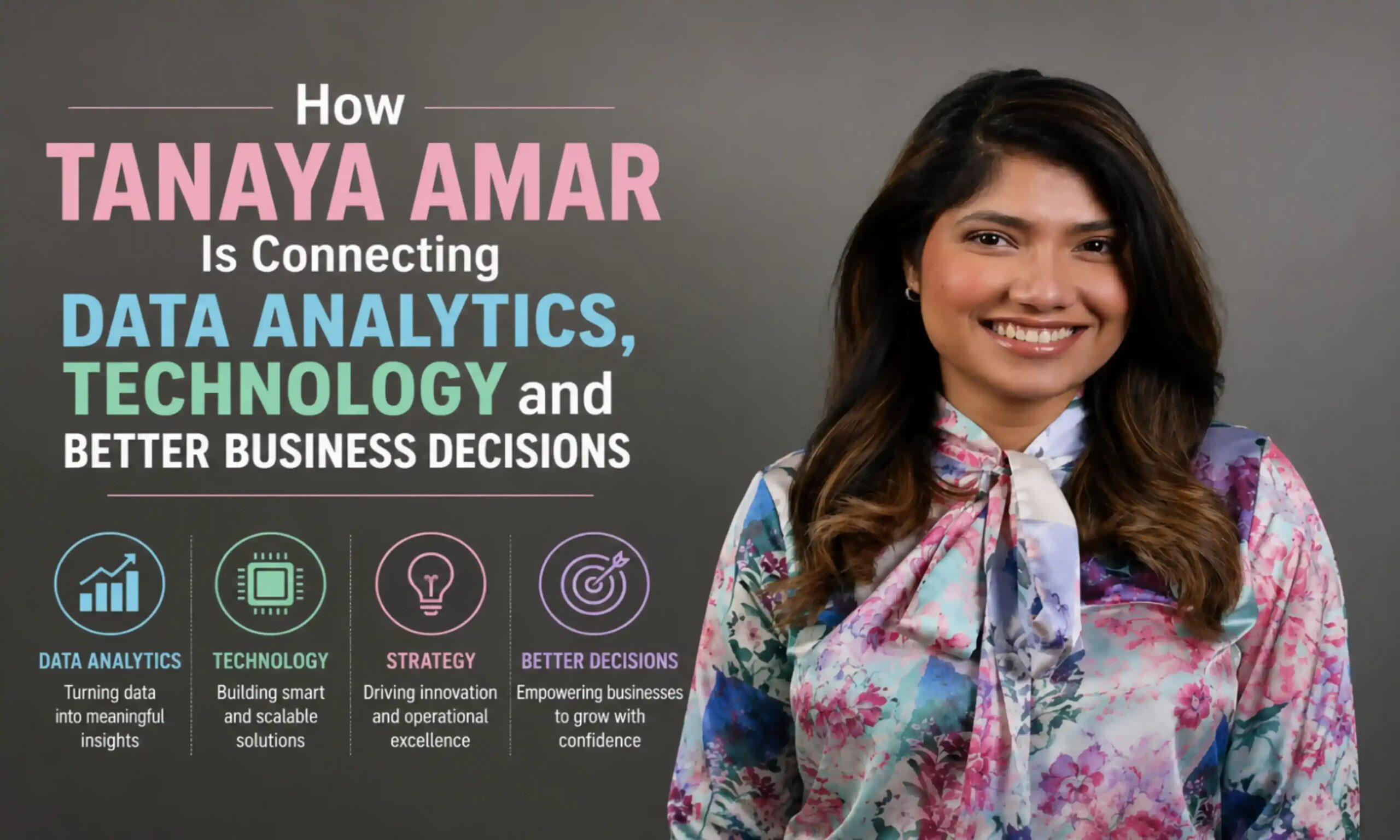
Across healthcare, insurance and medical technology, her work has focused on turning complex enterprise data into clearer insights for organizations and their decision-makers.
By Staff Correspondent
The nature of the challenge for business leaders has shifted in an age where organizations amass unprecedented amounts of information; it is no longer a matter of how to get the data, but rather what to make of it. This is particularly true for large entities like healthcare providers, insurers and technology firms that have to function across a host of different systems and reporting environments. If those sources are not in sync, one can expend considerable effort on what should be a simple query. It is here that analytics professionals come into their own, serving as the link between the raw numbers and the organization’s final decisions.
Tanaya Amar has made her career in precisely that arena. Over the course of eight years she has put in her time with data analytics, business intelligence and technology in such varied fields as e-commerce, medical technology and subscription-based models. Her resume includes stints at Accenture, CVS Health, Align Technology and eHealth, among others. In those roles she has been called upon to put together analytical frameworks, executive dashboards and customer insights for cross-functional teams.
Amar’s path is also indicative of the way the data field is widening its scope. She has turned her attention to artificial intelligence and healthcare tech, not only in her corporate work but by way of academic research and industry publications, and she has served as a judge and peer reviewer in the technology space. All told, she has had a hand in every part of the data ecosystem: from the construction of analytical systems to advising on the application of new technologies and the like.
From Engineering Management to Enterprise Analytics
It was an academic shift that wove together engineering, management and technology strategy that set Amar on her course in the U.S. tech industry. She came to the United States in 2017 for a Master of Engineering Management at Duke University; as a graduate student she was able to put her technical training in the context of business strategy and decision-making.Before that, Amar had cut her teeth at Accenture, providing support for eBay’s digital marketing in Europe. It was there she first saw how technology, the way customers behave and overall business performance are inextricably linked.
An internship with SBTDC in 2018 gave her some ground in the U.S., and in August 2019 she launched into a full-time career here. From then on her work has been more focused on analytics and business intelligence, in the main with healthcare and tech firms. Over time this has meant moving beyond the production of individual reports to take on roles in which she helps put in place the analytical structures and systems an organization needs to make sense of its performance from end to end.
Turning Fragmented Information Into Usable Intelligence
A case in point is the work Amar put in while at eHealth Insurance. The company is a data-heavy operation where everything from sales and marketing to product and data-science teams needs access to information in order to gauge performance and customer behavior.
In her own telling of it, Amar’s role there was to build out analytics and reporting frameworks that would do away with the manual spreadsheets and disconnected processes of the past. She put in place more automated and centralized solutions to supplant what had been a collection of fragmented dashboards. But the aim was not simply to put another dashboard on the wall; she wanted to foster a consistent environment for reporting so that various teams could draw on common measures and get at the information they needed without friction.That is a matter of some importance in enterprise analytics. A dashboard is only as good as the data architecture and definitions that underpin it; if one department is using its own calculations or keeping a separate version of a metric, an organization may have plenty of reports but little in the way of clarity.
Consequently, Amar has had to be as much an organizational player as a technical one, working with stakeholders to see what will inform their decisions before developing the solution. Her use of Tableau is illustrative of this. On one occasion she took it upon herself to solve a persistent technical issue with dynamic rolling 90-day success-rate figures. By overhauling the approach and standardizing the methodology, she put in place a far more dependable means of tracking those performance indicators. It is a pattern one sees throughout her career: the best analytical work is that which puts a practical end to a business problem, not just a matter of churning out numbers.
Analytics Behind a New Subscription Model
Amar’s time at Align Technology was a defining period in her career. The medical technology firm was in the process of rolling out its Doctor Subscription Program for orthodontic providers, a subscription model that called for an analytical infrastructure to underpin the new commercial approach and allow stakeholders to see how it was faring.
She took charge of the analytics development for the program from start to finish. This entailed putting in place KPI frameworks, operational reporting and the like, as well as executive dashboards. It was not a matter of simply choosing performance indicators; any new business model demands systems to monitor its trajectory from launch through to day-to-day operations. Executive reporting is the means by which one can get a read on the business, spot shifts in performance and provide leadership with a unified perspective.
In building the reporting infrastructure while accommodating the operational realities of a med tech company, Amar found herself right where analytics and business strategy meet. It is much the same in her wider work in insurance and healthcare, where she has made use of analytics to tie down business questions with hard data.
When Analytics Has to Work for People
One can easily lose sight of the human element in analytics when focused on the technicalities. But at the end of the day a data system is there to serve someone who has to make a decision. Be it an executive gauging the return on a business strategy, a product group appraising an initiative, a marketing team looking at customer behavior or a sales leader reviewing performance, the need is the same.
This link between data and the decisions it informs is something that has come to define Amar’s professional output. Her latest piece for Healthcare IT Today is a case in point. In it she takes on the issue of healthcare dashboards being swamped by competing priorities and an overabundance of filters and metrics. She makes the case for a more deliberate visual hierarchy and for distinguishing frontline operational reporting from exploratory work, all with a view to ensuring metrics are tied to the decisions they are meant to underpin.
It is an issue that speaks to a broader challenge in enterprise analytics. With the wealth of information now at an organization’s disposal there is an inclination to put more metrics into the reporting environment. The trouble is that volume does not equate to better decision making; in fact, absent proper governance and prioritization, it can be harder for the user to know where to focus. For this reason, Amar’s writing in the industry has moved on from the mere construction of analytics systems to address how they ought to be put to use.
The Growing Question of Trust in Healthcare AI
The relevance of that focus has only grown with the deeper penetration of artificial intelligence into healthcare analytics. Amar put this in perspective in an Fierce Healthcare Industry Voices piece from March 2026, where she looked at how AI, trust and data documentation intersect in the field. She recounted an instance of an AI assistant flagging a database as a likely source for a metric, yet a closer look showed the underlying data to be lacking in context and metadata.
Her point was clear: speed of access means little to an organization if it cannot vouch for the information being current, well defined and trustworthy. This is a matter of growing import as healthcare entities put their own AI-assisted analytics to the test. While AI is adept at expediting the search for information or unearthing patterns in an analysis, such utility is contingent on the governance and quality of the data fed into the system.
Amar’s recent writing puts her squarely in that debate, especially when it comes to responsible AI and the infrastructure behind it. Fierce Healthcare would have one see her as a seasoned data and analytics professional who has put in the work to build enterprise analytics and decision systems for the technology, insurance and healthcare sectors. In her commentary, she does not view AI as something in a silo; instead, she stresses the organizational practices and infrastructure needed to make sure the results are dependable.
From Industry Practice to Research
Amar is more than a commentator on the state of artificial intelligence in the industry; she has put her hand to the work as well. The official proceedings of the 15th International Conference on Data Science, Technology and Applications (DATA 2026) in Porto, Portugal, have her down as one of five co-authors for “Beyond Context Windows: Data Transformations at Scale with LLMs.”
In that paper, the research team sets out to solve the problem of enterprise datasets being too unwieldy for the conventional contexts of large language models. To do so, they put forward a framework for LLM-based transformation at the level of the whole dataset. It makes use of an agentic orchestration layer to turn plain-language goals into data-processing sequences, and relies on three operations: MAP, FILTER and REDUCE.
The numbers from their evaluation are telling. A 51,291-row agentic enrichment task was completed with 96.2 per cent accuracy, while a deduplication job of three million rows took just 1.90 hours. They have also made the framework available as open-source software.
For Amar, this is a natural progression of the kind of question she has been asking in one form or another over the course of her career: in what way can an organization render its complex data more useful while still holding on to the structure, accountability and consistency needed to make sound decisions?
A Role in the Wider Technology Community
There is more to Amar’s professional life than her day-to-day employment. She has put pen to paper for such outlets as Fierce Healthcare and Healthcare IT Today, the latter of which ran a recent piece by her as a guest article, crediting her as a Senior Analytics Professional.
Amar is also active in the technology and academic circles. Her work there has taken the form of peer review for international journals and conferences, and she has been a judge at various global technology and innovation competitions. In addition, she has held a position on the International Board of Reviewers for the Informing Science Institute.
In many ways these are hallmarks of the modern analytics profession. The field is one where business, engineering, research and healthcare converge. It is not enough for a practitioner to simply construct analytical systems; he or she must be able to put forth technical ideas, assess new methods and be part of the communities that are shaping tomorrow’s technology. One sees that wider role exemplified in what Amar does.
Building a Career Across Multiple Industries
One can also point to the variety of industries where Amar has put her analytics to use as a mark of her career. She has been with eHealth and CVS Health in the healthcare and insurance space, with Align Technology in medical technology, and in her early days was supporting eBay in e-commerce.
While these are distinct fields, the analytical work they present is much the same. Any organization must have a grasp on its customers, operations and performance; it requires systems for consistent measurement and reporting so that leaders can act on the information at hand. The particular questions may vary from one company to the next, but the call for sound analytical infrastructure is constant. This kind of cross-industry background has given Amar the opportunity to engage with all manner of enterprise data and stakeholder groups, yet she has kept a steady hand in converting raw information into business insight that is of practical value.
The Next Phase of Data-Driven Decision-Making
Expectations for analytics are being reshaped by the swift progress of artificial intelligence. There is a growing demand from organizations for systems that do more than simply put in a report on past events; they want to be able to query why things happened, spot patterns and have a natural language dialogue with their data.
At the same time, this evolution poses its own set of problems. An organization has to figure out how to bring AI into its current data environment while maintaining a degree of accountability and reliability. It is an intersection Amar has made a point of in her industry writing and research of late.
Her approach is twofold. With LLM-driven data transformation she looks at the capacity of AI to handle large volumes of data, whereas in her healthcare pieces the focus is on the necessity of good governance, documentation and clarity in any analytical work supported by AI. The two are of a piece. One is concerned with the scale of what these new systems can accomplish, the other with making sure the information they are working with is something an organization can trust and make sense of. Given the level of investment businesses are putting into AI, one can expect both to matter more and more.
Connecting Technology with Decision-Making
There is a simple enough premise to the career of Tanaya Amar: data is only as valuable as its ability to inform better decision making. She has put that to work in a number of settings, ranging from e-commerce and digital marketing to the more exacting worlds of healthcare, insurance and medical technology. The technical particulars may vary from one to the next, but the job at hand is always much the same – to make sense of complicated information and present the insights in a way that is of use to those who must act on them.
Lately she has brought a new dimension to her efforts with research and writing on artificial intelligence. That, along with her background in enterprise analytics and involvement in both academic and professional circles, puts her in good stead in a field that is not standing still. With organisations shifting from old school business intelligence to AI-assisted systems, there will be a continued need for people who can bridge the gap between the technology and the business it serves.
Amar’s path has been to do just that. She applies her analytical skills to real organisational problems while also having a part in the broader discussion on the proper use of AI and data. In the end, her career is a case in point for the evolution of analytics. It is no longer about reporting on past events; it is about helping an organization see what the numbers mean and how to bring in new technologies in a way that does not compromise trust or human judgment.
About Tanaya Amar
Tanaya Amar is a technology and data analytics professional with more than eight years of experience across business intelligence, enterprise analytics, healthcare, insurance, medical technology and technology-driven businesses. Her professional experience includes work associated with eHealth, Align Technology, CVS Health and Accenture. She holds a Master of Engineering Management from Duke University and has contributed to industry publications and research on healthcare analytics, artificial intelligence and data transformation. She is also involved in academic peer review and technology and innovation judging.
 Print
Print
 Download